
Abstract
Humanity is not short of good economic ideas. Over the past two generations, distinct intellectual traditions - ecological economics, Doughnut Economics, post-growth thought, the Sustainable Development Performance Indicators (SDPI) and Common Good Matrix, endogenous money theory, ergodicity economics, complexity economics, cybernetics, systems dynamics, steward ownership, cooperative governance, institutional economics, bioregionalism, regenerative economics and collapsology - have each diagnosed part of what is wrong with industrial-era capitalism and proposed part of what should replace it. What’s missing are institutionalized entities capable of holding all of these insights together and turning them into the daily, unglamorous work of redefining finance and its economic outcomes for communities. In this piece, I argue that these traditions are not competing paradigms but complementary descriptions of a single socio-economic system, and I trace how a financial institution dedicate for its operationalization would have to look like if it were built, from the ground up, to hold all of them at once. I situate the argument in a larger scientific narrative: the shift from a mechanistic to a living-systems worldview, already under way in physics, biology and ecology, has not yet been completed in economics and banking - and regenerative finance is what banking looks like once it has.
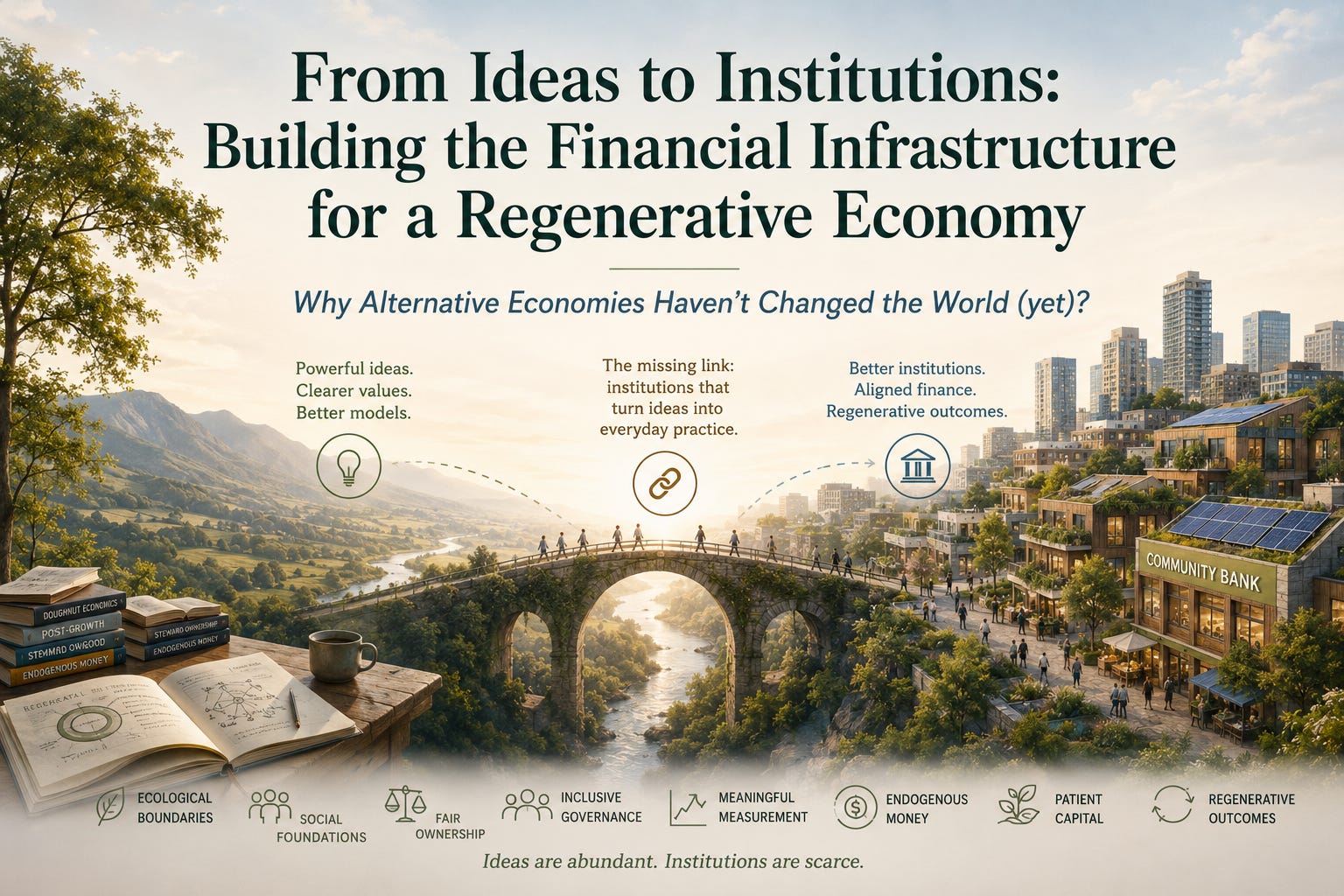
Introduction: We Don’t Lack Ideas - We Lack Institutions
Humanity is not short of ideas for how to build a better economy. Over the past twenty-five years many ideas emerged - Kate Raworth reframed the goal of economic activity itself with Doughnut Economics, showing that prosperity means staying within both an ecological ceiling and a social floor rather than maximizing output. Tim Jackson, Jason Hickel and Giorgos Kallis, building on the Club of Rome’s foundational modelling in The Limits to Growth, have made post-growth and degrowth economics academically respectable rather than fringe. Christian Felber’s Economy for the Common Good and UNRISD’s Sustainable Development Performance Indicators have shown, in painstaking methodological detail, how value can be measured beyond financial return. Steward ownership, championed by the Purpose Foundation, has offered a legal answer to who should control productive assets. Bioregionalism, cooperative governance, institutional economics, complexity science, cybernetics, collapsology along with many others have each supplied indispensable pieces of the puzzle.
Taken together, they describe an economy that should be more bounded, more resilient, more democratic, more local and more life-supporting than the one we have inherited. What they do not yet provide, at least not in one place, are institutional forms capable of turning that intellectual abundance into everyday financial practice.
That gap matters because the transition to a regenerative economy will not be decided by theory alone. It will be decided by whether the institutions that create and allocate money are designed to finance the future we say we want, or to keep reproducing the one we already have. A great deal of contemporary economic thinking assumes that better outcomes will follow from better ideas, better values, or better policy frameworks. Those things matter, but they are not enough. If the basic machinery of credit creation continues to reward speculation, asset inflation and fossil dependency, then even the most sophisticated vision of transformation will remain underfunded.
This is why the central question is not whether regenerative agriculture is desirable, whether circular production is necessary, or whether cooperative enterprise is worth supporting. It is whether the banking system is capable of systematically creating credit for those activities in the first place. Advocates of transition often speak as if finance will somehow appear once the right projects are ready. In reality, the deeper question comes first: what kind of banking system creates money for productive, regenerative and socially useful activity, rather than for real-estate speculation, financial trading and fossil infrastructure?
Seen this way, regenerative economics is more then just a set of values or a policy agenda. It is the demand that finance itself be redesigned as a living part of the economy, rather than treated as a neutral channel sitting above it. That means asking not only what the economy should do, but what kind of financial institution would be required to make such an economy possible.
My central claim is simple to state and, I believe, genuinely useful in practice:
The transition to a regenerative economy will not happen because someone invents one single better economic theory. It will happen when complementary ideas about value, ownership, money, governance and ecological regeneration become embedded in institutions capable of allocating capital differently.
The rest of this essay follows that claim to its logical conclusion.
Mechanistic Economics and the Science of Living Systems
It would be easy to frame this as a critique of neoliberalism. I deliberately avoid that framing, not because such critiques are wrong, but because they invite an ideological debate that obscures a more useful and more enduring claim: economics, as an applied science, has fallen behind the rest of science.
Every civilization organizes itself around a set of assumptions about how the world works, and those assumptions shape its institutions, its technologies and its social contract implemented through the economy. The industrial economy was built on the best available scientific knowledge of its era. From classical mechanics it inherited a vision of predictable systems tending toward equilibrium, governed by optimization and amenable to centralized control. Neoclassical economics translated these mechanistic ideas into the language of markets, firms and general equilibrium; twentieth-century neoliberalism became the dominant institutional expression of that translation. This worldview proved extraordinarily effective at mobilizing capital, expanding production and, for a period, raising material living standards.
But over the past seventy years, science itself has moved on. Ecology, cybernetics, complexity theory and Earth-system science describe a world characterized not by static equilibrium but by feedback, adaptation, emergence, nonlinearity and hard planetary limits. Norbert Wiener’s founding statement of cybernetics as “control and communication in the animal and the machine” (1948), W. Ross Ashby’s Introduction to Cybernetics (1956) and its Law of Requisite Variety, and the complexity economics associated with the Santa Fe Institute and scholars such as W. Brian Arthur and Eric Beinhocker, have given us a far richer scientific vocabulary for describing how complex adaptive systems - ecosystems, brains, immune systems, cities and, plausibly, economies - actually behave. Ole Peters’ ergodicity economics has shown that the mathematics conventionally used to model rational decision-making silently assumes an ergodic world in which time averages equal ensemble averages - an assumption that is false for real economic actors facing irreversible loss, and whose falseness has concrete consequences for how a financial sector should think about risk. Those concepts all point in the same direction: real systems are dynamic, path-dependent and vulnerable to irreversible loss. The economy, in other words, is not a machine sitting outside nature; it is one evolving part of a larger living system.
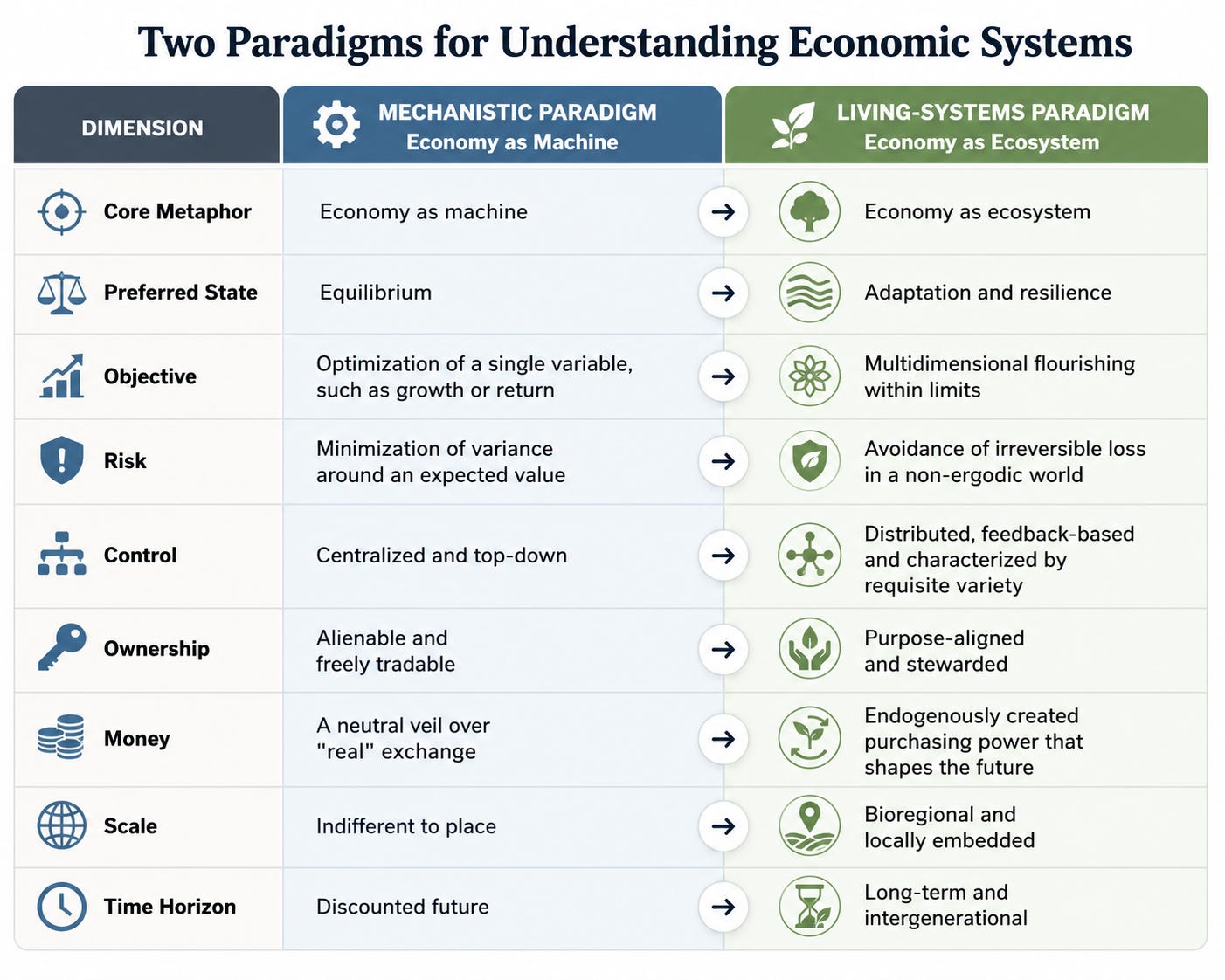
That distinction is not philosophical decoration. It changes how we understand risk, control, ownership and time. A mechanistic model asks how to optimize a stable system around a single objective. A living-systems model asks how to preserve resilience in a world of feedback, uncertainty and limits. One assumes that control should be concentrated at the top; the other assumes that governance must be distributed, adaptive and capable of learning. One treats the future as something to discount; the other treats the future as something to steward.
Mainstream financial institutions still largely operate as though the economy were a machine to be optimized rather than a living, evolving system to be cultivated. Stafford Beer captured the underlying question decades ago when he asked, in effect: if organizations are living systems, why do we insist on governing them as though they were machines? The same question should be asked of the economy as a whole, and of the banking system as the heart of the economy that channels its lifeblood.
This particularly matters because banking does not merely move money around an already existing economy. Banking shapes what kinds of economic activity become possible in the first place. If finance is designed around short-term return, then it will tend to amplify short-term return. If it is designed around resilience, social usefulness and ecological integrity, then it can become an instrument for cultivating those outcomes instead. The deeper problem is therefore not that there are too few good projects, but that the dominant financial architecture still behaves as if money were neutral and capital allocation were merely technical.
Consequently, regenerative economics is not a political programme but the economic expression of a more up-to-date scientific understanding of how living systems function. The question that follows is no longer whether the economy needs to change, but what kind of financial institution would be required to facilitate such a change and make it durable.
Figure 1 summarizes the contrast not as a matter of left versus right, but as two different scientific paradigms for understanding economic systems.
Understanding the Problem: What the Current Financial System Actually Optimizes For
To see why a new institutional layer is needed, it helps to be precise about what the existing financial system already optimizes for extremely well. Conventional finance is highly effective at maximizing short-term financial returns, supporting perpetual asset-price appreciation, expanding debt, concentrating ownership and shortening investment horizons. These are not accidents or failures of individual bankers; they are the predictable output of an institutional design whose incentive structure rewards exactly these outcomes.
The consequences are visible at the planetary scale. Rockström et al. (2009) and the updated assessment by Steffen et al. (2015)demonstrated that human activity has already pushed several Earth-system processes - climate change, biodiversity loss, biogeochemical flows - beyond the boundaries within which a “safe operating space for humanity” can be maintained. The most recent empirical update of Raworth’s own framework, Fanning and Raworth’s 2025 Nature paper tracking the doughnut of social and planetary boundaries, confirms that the world remains simultaneously short of the social foundation (too many people lack the essentials of a dignified life) and over the ecological ceiling (several planetary boundaries are breached) - precisely the double failure that Doughnut Economics was designed to make visible.
Very little of this is a mystery to economists. The mystery is why capital allocation has not changed proportionately. The answer lies in what current finance treats as an afterthought: it mostly finances real-estate speculation, mergers and acquisitions, financial-asset trading, fossil-fuel infrastructure and consumption debt, while starving regenerative local economic activity of capital. This is not because such activity is unprofitable in principle. It is because the institutions doing the allocating are structurally built to optimize for something else: financial return over a short horizon, evaluated with tools that assume statistically stable risk and ignore the path-dependent nature of real economic life.
That matters because real economies do not unfold like textbook averages. In a non-ergodic world, what looks attractive on paper across many hypothetical scenarios can still produce ruin in the one actual world we inhabit. A financial system that optimizes for expected return while ignoring irreversible loss will systematically favour activities that appear safe in the abstract but are dangerous in reality. The result is not only mispricing, but misdirection: resources flow toward activities that deepen fragility and away from those that build resilience.
Meanwhile, Servigne and Stevens’ collapsology and the systemic-risk research of scholars such as Danilo Brozović and Balázs Stumpf-Biró remind us that highly interconnected societies are not merely at risk of gradual decline but of rapid, nonlinear collapse once critical thresholds are crossed. A financial system that optimizes for short-term returns while ignoring these dynamics is, in effect, optimizing against its own long-term survival. The deeper problem is therefore not just that current finance is incomplete; it is that it is oriented toward the wrong future.
This is the diagnosis on which nearly every school of thought surveyed here agrees, even when they use different vocabularies to describe it: the economy is currently governed by an institutional design mismatched to both the ecological reality it depends on, social needs it needs to fulfill and the complex, non-ergodic dynamics it actually exhibits.
Every School Solves One Piece of the Puzzle
If the diagnosis above is correct, the natural next step is not to ask which single theory should replace mainstream economics, but to ask what distinct question each existing tradition is best equipped to answer. Framed this way, what looks like a crowded and competitive field of alternative economics resolves into a coherent division of intellectual labour. Three fundamental questions organize the whole: what should the economy optimize for, how do complex socio-economic systems actually function, and what institutions can embody those principles in practice.
That structure matters because no single tradition answers all three questions. Ecological economics and Doughnut Economics tell us what a bounded, flourishing economy would have to respect. Endogenous money theory and complexity science explain how credit, feedback and adaptation actually work. Steward ownership, cooperative governance and institutional economics begin to show what sort of institutional form could hold those insights together. Put differently, the literature is not fragmented because it is confused; it is fragmented because each school is illuminating one layer of a larger architecture.
Framed this way, what looks like a crowded and competitive field of “alternative economics” resolves into a coherent division of intellectual labour. Three fundamental questions organize the whole:
1. What should the economy optimize for? - Ecological economics, Doughnut Economics, post-growth thought, SDPI and the Common Good Economy.
2. How do complex socio-economic systems actually function? - Cybernetics, systems dynamics, complexity economics, endogenous money theory, ergodicity economics.
3. What institutions can embody those principles in practice? - Steward ownership, cooperative governance, bioregional organization, institutional economics, non-extractive financial institutions
What should the economy optimize for?
The first question is not how to make the existing economy a little more efficient. It is what the economy is supposed to be for in the first place. Ecological economics, Doughnut Economics and post-growth thought all begin from the same basic recognition: an economy is not an abstract machine for maximizing output, but a human system embedded in ecological limits and social obligations. Once that is accepted, prosperity can no longer mean simply more production, more consumption or more financial turnover. It has to mean enough for everyone, within the boundaries of a living planet.
Ecological economics (Daly & Farley, Ecological Economics: Principles and Applications) makes the point at the most fundamental level: the economy is a subsystem of society, and society is a subsystem of the biosphere. That means economic activity cannot be treated as if it could expand indefinitely without consequence. Doughnut Economics (Raworth, 2017; Fanning & Raworth, 2025) gives that insight a form that is easy to grasp: a just economy must stay within a social floor and an ecological ceiling at the same time. Post-growth (Tim Jackson, Jason Hickel, Giorgos Kallis, and the Club of Rome’s Earth4All initiative) thought pushes the argument one step further by questioning whether perpetual GDP growth should remain the central organizing principle of mature economies at all.
For a financial institution, these are not philosophical abstractions. They imply that lending should not be judged only by return, volume or speed, but by the kind of future it makes possible. A bank that finances housing speculation, fossil infrastructure or extractive expansion is not simply making “neutral” credit decisions; it is choosing a model of prosperity that is incompatible with ecological stability and social resilience. Contrary, a bank designed for a regenerative economy would therefore have to ask a different question at the outset: does this loan help keep the economy within planetary limits while strengthening the social foundations people depend on?
That leads directly to measurement. If an institution only measures financial return, then financial return will dominate. If it measures ecological and social outcomes as part of value creation, then capital allocation begins to change. This is why SDPI and the Common Good Matrix matter so much in the argument: they make visible the simple but decisive principle that what gets measured gets financed, and what gets financed becomes normal.
The deeper point is that value is never neutral. Every credit decision expresses a theory of what matters and what deserves to grow. The real question, then, is not whether banks influence the economy. They already do. The question is whether they will keep channeling that power toward accumulation and extraction, or redirect it toward sufficiency, resilience and regeneration.
How do complex socio-economic systems actually function?
If the first question is what the economy should optimize for, the second is how it actually behaves. This matters because a financial institution built on the wrong model of reality will keep producing the wrong outcomes, even if its intentions are good. Complexity economics, cybernetics, systems dynamics, endogenous money theory and ergodicity economics all push in the same direction: economies are not closed, stable machines, but open, adaptive systems shaped by feedback, learning, uncertainty and path dependence.
Endogenous money theory (Basil Moore; Richard Werner; Paolo Dini; and the Bank of England’s own 2014 account) asks what money actually is, and answers that money is not a scarce commodity but a social institution created through credit relationships. Banks do not merely recycle pre-existing savings; they create purchasing power when they extend credit. That means every loan is not just a financial transaction but a decision about which future gets brought into being. Once this is understood, banking stops looking like a neutral plumbing system and starts looking like one of the most powerful steering mechanisms in modern society.
Ergodicity economics (Ole Peters; Peters & Gell-Mann; the practitioner community around ergodicityeconomics.com and the London Mathematical Laboratory, including work associated with Graham Boyd and Greg Fisher on decision-making under genuine uncertainty) sharpens the point by showing why expected value is not enough in a non-ergodic world. A strategy that looks profitable on average across many hypothetical cases can still be disastrous for the one community, business or household actually living with the consequences.
Complexity economics (W. Brian Arthur; Eric Beinhocker; J. Doyne Farmer; the Santa Fe Institute) adds another layer. Economies evolve through feedback, emergence and adaptation, so static models calibrated to a supposedly stable world are always incomplete. That is why banking cannot be reduced to a fixed rulebook applied uniformly from above. A system that serves many different local economies needs a structure that can learn, adjust and remain responsive to changing conditions.
Cybernetics (Norbert Wiener; Stafford Beer’s Viable System Model; W. Ross Ashby) then tells us what good governance looks like under those conditions. If the environment is complex, control cannot be wholly centralized without losing the variety needed to respond effectively. The principle of requisite variety suggests that a distributed banking network should combine local autonomy with a shared backbone for compliance, treasury, payments and risk management. In practical terms, that means the people closest to the real economy should have real decision-making power, while the expensive and standardized parts of the system are centralized where that creates coherence.
Systems dynamics (Jay Forrester and the System Dynamics Society; Donella Meadows’ Leverage Points)completes the picture by showing where intervention matters most. Lending criteria shape investment, investment shapes production, production shapes social and ecological outcomes. A bank’s credit policy is therefore not just a reflection of the economy; it is one of the main levers through which the economy itself is structured. That is why redesigning credit allocation is so central to the whole argument.
The point of this section is not to add complexity for its own sake. It is to show that the tools already exist for understanding the economy as a living system rather than a machine. Once that shift is made, the missing core institution for initiating economic transition becomes easier to name: a bank designed to allocate credit in ways that reflect feedback, resilience, stewardship and real-world constraints.
What institutions can embody those principles in practice?
Theory points to practice when institutions are redesigned to lock in values, distribute authority, measure what matters and use credit as a steering tool rather than a passive commodity. Steward ownership shows how control can be permanently aligned with purpose rather than shareholder extraction, making mission drift legally difficult rather than merely culturally discouraged.
Cooperative governance Ostrom-style commons governance and stewardship ownership (Purpose Foundation; Melanie Rieback) provide tried-and-tested blueprints for meaningful participation: those affected by decisions must have real voice and enforcement mechanisms, not just consultative PR. Embedding local partners in origination and monitoring creates the requisite variety a distributed financial network needs to respond to diverse, place-based realities.
Endogenous-money-aware institutions treat credit creation as an explicit policy lever, not an accidental by-product; that requires governance structures that specify who gets to decide which futures are financed. Measurement frameworks such as SDPI and the Common Good Matrix convert values into operational constraints so that capital allocation is assessed by ecological and social outcomes alongside prudential metrics.
Bioregionalism and regenerative-economic practice reshape scale and targets: banks oriented to bioregions lend into locally anchored supply chains, housing, energy and food systems rather than fungible global asset markets. Public- and philanthropic-first-loss capital, blended finance and patient catalytic investors can be combined to make below-market pricing and long-term, resilient projects financially viable.
Put together, these institutional building blocks show one practical pathway from worldview to balance sheet: legal mission locks, layered governance (local originators + centralized backbone), impact-first measurement embedded in credit policy, and funding stacks that use patient capital and public leverage to redirect endogenous money toward regeneration rather than speculation.
Figure 2 summarizes this architecture as a set of layers, each answering a distinct question, moving from worldview down to measurable ecological and social outcome
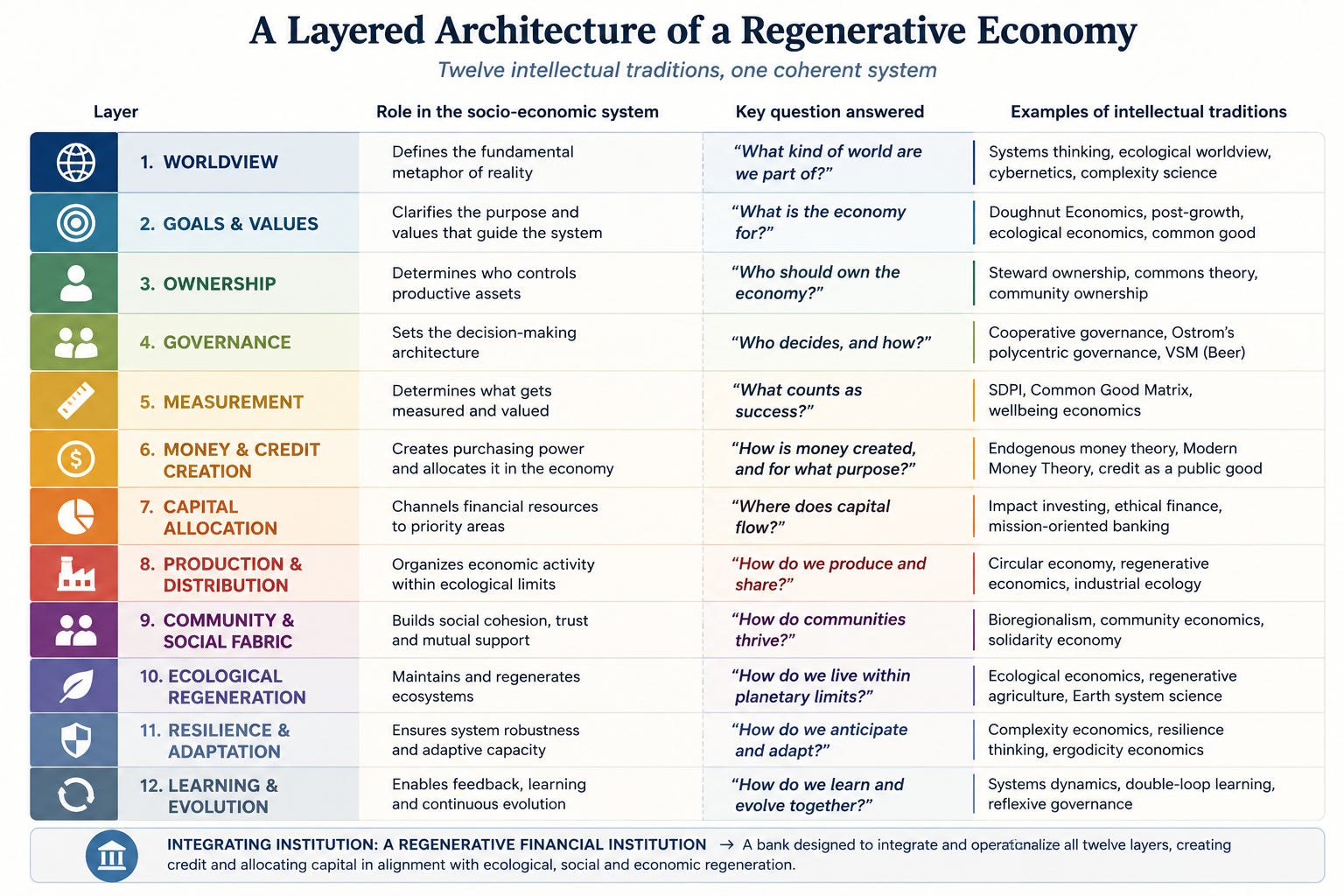
Read from top to bottom, this is a causal chain: worldview shapes values, values shape who is entrusted with ownership and governance, governance shapes what gets measured, measurement shapes what gets financed, financing shapes economic activity, and economic activity ultimately determines ecological, social and systemic outcomes. Read from bottom to top, it is a diagnostic chain: any unsatisfactory outcome can, in principle, be traced back through capital allocation, money creation, measurement, governance, ownership and values to an underlying worldview.
No single tradition surveyed here claims to operate at every layer. That is not a weakness of any of them; it is the natural consequence of academic specialization, and it is precisely why an institution is needed that can hold every layer simultaneously.
The Missing Link
Every one of the movements above implicitly assumes that someone, somewhere, will finance the transition it calls for. Advocates of regenerative agriculture assume that credit will be available for regenerative farmers. Advocates of circular production assume that circular manufacturers will be financeable. Advocates of cooperative enterprise assume that cooperatives will be able to raise capital on fair terms. Very few of these movements ask the more fundamental question directly: how will the banking system systematically create credit for these activities, rather than for real-estate speculation, financial trading and fossil infrastructure?
This is where the role of the banks as cornerstones and hearts of the financial system comes in. Banks are institutions that have exclusive role in the management of the community assets. As they create new purchasing power at the moment they extend a loan, the question facing society is no longer whether money will be created, but for what purpose. That is a profound shift in framing. It converts banking from a passive intermediation service into what is arguably the most powerful, least examined steering mechanism a modern economy possesses.
Existing banking systems, as documented above, mostly steer that mechanism toward real-estate speculation, mergers and acquisitions, financial-asset trading, fossil-fuel infrastructure and consumption debt. Just a fraction of it systematically supports regenerative local economic activity. My conclusion is therefore not that we need better regenerative projects - many already exist and are underfinanced - but that we need institutions that distribute money and investments differently.
That is also a question I asked myself directly while working through this material: why has no one yet assembled precisely this synthesis? Several plausible reasons emerge. Academic incentives reward specialization rather than synthesis; interdisciplinary work is intellectually demanding and often harder to publish in leading disciplinary journals than a novel contribution within a single field. Each movement, quite naturally, tends to treat its own framework as the central one - Doughnut Economics emphasizes ecological and social boundaries, degrowth emphasizes material throughput, the Common Good Economy emphasizes measurement, steward ownership emphasizes governance, endogenous money scholars emphasize banking, complexity economists emphasize emergence, cyberneticians emphasize feedback and control - and all are partly right, without any one framework needing to be the whole story.
Few of these traditions have had access to a convincing institutional container: many books explain what is wrong and what should change; far fewer explain, in operational detail, what a financial institution should look like if it were designed from these principles from the ground up. And systems thinkers who understand governance deeply - cybernetics, systems dynamics, complexity science - have historically engaged relatively little with the specifics of ownership, banking and capital allocation, while monetary economists have engaged relatively little with the language of feedback, emergence and requisite variety. The two conversations have largely passed each other by.
An analogy from biology may be useful here. Imagine several scientists each studying one system of the human body - one the nervous system, another circulation, another respiration, another digestion, another genetics. Each develops an excellent, rigorous theory of their own subsystem. None of these theories is wrong. What is missing, until someone says it explicitly, is the observation that they are all describing one organism. Saying so does not invalidate any of the specialized sciences; it reveals their relationships, and makes it possible to ask questions - about health, about disease, about resilience - that no single subsystem theory could answer on its own. My claim about regenerative economics is of exactly that kind: the various schools surveyed above are not competing paradigms but complementary descriptions of different dimensions of a single socio-economic system, and what has been missing is the organism - the institutions - in which all these subsystems operate together.
I don’t think that institutions have to remain hypothetical. In the next article I will present you some of the work I’m involved in and whose aim is to operationalize one of such institutions - a fully-compliant banking entity on the European level to pivot the financial infrastructure emboding all of previously mentioned knowledge into a heart giving a beat to the necessary economic transition.
For those who cannot wait the next article, you can find some additional information on the website of Echoes Holding Societa Benefit.


References
1. Arthur, W. B. Complexity and the Economy. Santa Fe Institute. https://sites.santafe.edu/~wbarthur/Papers/EconandComplex_Web.pdf
2. Ashby, W. R. (1956). An Introduction to Cybernetics. https://ashby.info/Ashby-Introduction-to-Cybernetics.pdf
3. Bank of England (2014). “Money Creation in the Modern Economy.” Quarterly Bulletin 2014 Q1. https://www.bankofengland.co.uk/-/media/boe/files/quarterly-bulletin/2014/quarterly-bulletin-2014-q1.pdf
4. Beer, S. Viable System Model, as documented by Metaphorum. https://metaphorum.org/staffords-work/viable-system-model
5. Beinhocker, E. The Origin of Wealth: Evolution, Complexity, and the Radical Remaking of Economics. Harvard Business Review Press. https://store.hbr.org/product/the-origin-of-wealth-evolution-complexity-and-the-radical-remaking-of-economics/777X
6. Berg, P. & Dasmann, R. “Bioregionalism: An Introduction.” Planet Drum Foundation. https://planetdrum.org/bioregionalism-an-introduction/
7. Brozović, D. “Societal Collapse: A Literature Review.” Google Scholar profile. https://scholar.google.com/citations?user=lH_toS4AAAAJ&hl=en
8. Club of Rome. The Limits to Growth (1972). https://www.clubofrome.org/publication/the-limits-to-growth/
9. Club of Rome / Dixson-Declève, S. et al. (2022). Earth for All: A Survival Guide for Humanity. https://www.clubofrome.org/publication/earth4all-book/;
https://earth4all.life/
10. Daly, H. E. & Farley, J. Ecological Economics: Principles and Applications. https://library.uniteddiversity.coop/Measuring_Progress_and_Eco_Footprinting/Ecological_Economics-Principles_and_Applications.pdf
11. Dini, P. LSE Media and Communications staff profile. https://scholar.google.com/scholar?hl=en&as_sdt=0%2C5&q=Paolo+Dini+money&btnG=
12. Echoes S.r.l. SB (European Ethical Bank). Corporate site and public disclosures.
https://www.echoes-holding.eu
13. Economy for the Common Good. Common Good Matrix. https://www.econgood.org/apply-ecg/common-good-matrix/
14. Fanning, A. L. & Raworth, K. (2025). “Doughnut of Social and Planetary Boundaries Monitors a World Out of Balance.” Nature. https://www.nature.com/articles/s41586-025-09385-1
15. FEBEA (Federation of European Ethical and Alternative Banks and Financiers).
https://febea.org/
16. Felber, C. Change Everything: Creating an Economy for the Common Good. https://christian-felber.at/en/books/change-everything/
17. Fullerton, J. (2015). Regenerative Capitalism: How Universal Principles and Patterns Will Shape Our New Economy. Capital Institute. https://capitalinstitute.org/wp-content/uploads/2015/04/2015-Regenerative-Capitalism-4-20-15-final.pdf
18. GABV (Global Alliance for Banking on Values).
https://www.gabv.org/
19. Hickel, J. Less Is More: How Degrowth Will Save the World. https://www.jasonhickel.org/less-is-more
20. Jackson, T. Prosperity Without Growth. CUSP. https://cusp.ac.uk/themes/aetw/pwg/
21. Kallis, G. Limits: Why Malthus Was Wrong and Why Environmentalists Should Care. Reviewed in Environmental Politics.https://www.tandfonline.com/doi/full/10.1080/09644016.2020.1718875
22. Meadows, D. (1999). “Leverage Points: Places to Intervene in a System.” https://donellameadows.org/wp-content/userfiles/Leverage_Points.pdf
23. Moore, B. J. (1988). Horizontalists and Verticalists: The Macroeconomics of Credit Money. https://archive.org/details/horizontalistsve0000moor
24. North, D. C. Nobel Prize lecture (1993). https://www.nobelprize.org/prizes/economic-sciences/1993/north/lecture/
25. Ostrom, E. (1990). Governing the Commons: The Evolution of Institutions for Collective Action. Cambridge University Press; Nobel Prize lecture. https://www.nobelprize.org/uploads/2018/06/ostrom_lecture.pdf
26. Peters, O. (2019). “The Ergodicity Problem in Economics.” Nature Physics. https://www.nature.com/articles/s41567-019-0732-0
27. Peters, O. & Gell-Mann, M. (2016). “Evaluating Gambles Using Dynamics.” Chaos (preprint). https://arxiv.org/abs/1405.0585
28. Purpose Foundation. “Steward-Ownership: Because Ownership Matters.” https://steward-ownership.com/en; “Steward-Ownership Aligned Financing.” https://purpose-economy.org/content/uploads/purpose-foundation_steward-ownership-aligned-financing.pdf
29. Raworth, K. (2017). Doughnut Economics: Seven Ways to Think Like a 21st-Century Economist. https://www.penguinrandomhouse.com/books/800774/doughnut-economics-by-kate-raworth/
30. Raworth, K. (2017). “Why It’s Time for Doughnut Economics.” IPPR Progressive Review. https://onlinelibrary.wiley.com/doi/abs/10.1111/newe.12058
31. Rieback, M. Interview, “The Case for Steward Ownership and Open Source.” Snyk podcast. https://snyk.io/podcasts/the-secure-developer/the-case-for-steward-ownership-and-open-source-with-melanie-rieback/
32. Rockström, J. et al. (2009). “Planetary Boundaries: Exploring the Safe Operating Space for Humanity.” Ecology and Society. http://www.ecologyandsociety.org/vol14/iss2/art32/
33. Servigne, P. & Stevens, R. (2020). How Everything Can Collapse: A Manual for Our Times. https://polycrisis.org/resource/how-everything-can-collapse-a-manual-for-our-times/
34. Steffen, W. et al. (2015). “Planetary Boundaries: Guiding Human Development on a Changing Planet.” Science. https://www.science.org/doi/10.1126/science.1259855
35. Stumpf-Biró, B. Interview, Libri Magazin. https://magazin.libri.hu/interju/minden-fontosabb-annal-ami-mindennel-fontosabb-interju-stumpf-biro-balazs-osszeomlaskutatoval/
36. UNRISD. Sustainable Development Performance Indicators (SDPI). https://sdpi.unrisd.org/platform/
37. Wahl, D. C. Designing Regenerative Cultures. Triarchy Press. https://www.danielchristianwahl.com/englishbook
38. Werner, R. A. (2014). “Can Banks Individually Create Money Out of Nothing? The Theories and the Empirical Evidence.” International Review of Financial Analysis. https://www.sciencedirect.com/science/article/pii/S1057521914001070
39. Wiener, N. (1948). Cybernetics: Or Control and Communication in the Animal and the Machine. https://archive.org/details/mit_press_book_9780262355902
40. ZEF (Zadruga za etično financiranje / Cooperative for Ethical Financing), the Croatian cooperative from which this effort originally grew.
https://zef.hr/
European Social Fund Plus case study. https://european-social-fund-plus.ec.europa.eu/en/social-innovation-match/case-study/cooperative-ethical-financing-zef